- Time needed
- Allow far longer than the map suggests in the 7–9am a…
- Getting there
- Match the mode to your hotel area: rail wins for stat…
- Best for
- First arrivals weighing speed
First, know which airport you've landed at
Bangkok is served by two airports that confuse a lot of first-timers. Suvarnabhumi (code BKK) sits to the southeast of the city and handles most full-service international flights. Don Mueang (code DMK) is the older airport to the north and is the hub for low-cost and regional carriers. They are a long way apart in Bangkok traffic, so if you ever need to transfer between them, give yourself a generous buffer.
Whichever you land at, the goal is the same: reach your neighborhood without overpaying or getting stuck in gridlock. The right answer depends on three things — which airport, what hour it is, and how much luggage you are hauling. The two airports also have very different connections, so each has its own detailed page below. This page is the decision layer that sits above them.
- Suvarnabhumi (BKK): most international and full-service flights, with a direct rail link.
- Don Mueang (DMK): low-cost and regional carriers, with bus and rail connections rather than an airport train at the door.
- Check your boarding pass for the code before booking any onward transport.
Watch out
Ignore anyone approaching you inside arrivals offering a taxi or 'special price' limousine — use the official metered-taxi rank downstairs or a fixed-fare app
From Suvarnabhumi (BKK): rail, taxi, Grab or transfer
The Airport Rail Link is the fastest, cheapest and most predictable way into town from Suvarnabhumi, because it sails over the traffic on an elevated line. It runs from the airport to interchange stations where you can connect onto the BTS Skytrain and the MRT subway, so it is the obvious pick when your hotel is near the line and you are traveling reasonably light. With heavy suitcases at midnight, the stairs and crowds tilt the choice toward a taxi or a Grab.
For door-to-door comfort, the official metered-taxi rank is downstairs from arrivals; take a ticket if there is a queue system and a marshal will assign you a car. Confirm the driver uses the meter, and have small notes ready for tolls and the airport surcharge. Grab and other ride-hailing apps give you a fixed fare shown upfront, with a designated pickup point that the app will direct you to — often the simplest option late at night or with kids. A pre-booked private transfer or hotel car costs more but removes every decision on arrival.
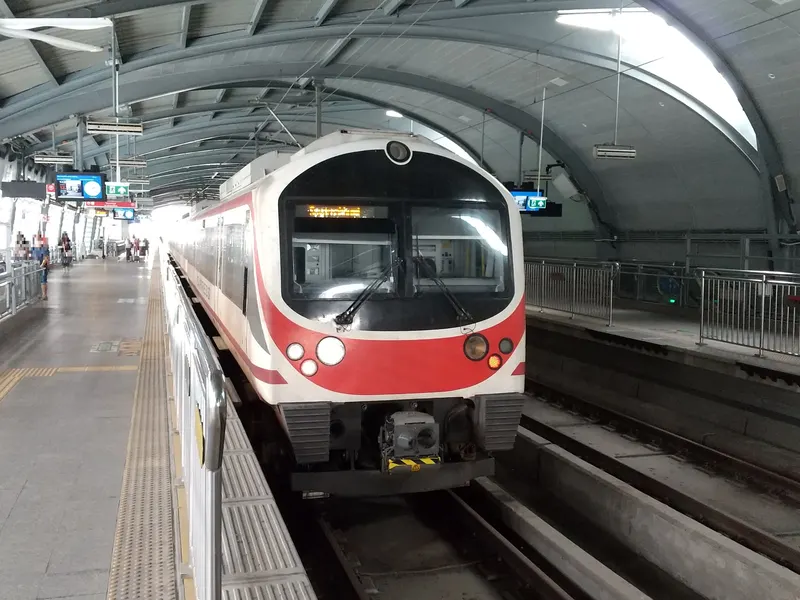
- Airport Rail Link: traffic-proof and cheap when your hotel is near the line; lighter on luggage capacity.
- Official metered taxi: door-to-door, downstairs rank only, meter plus airport surcharge and tolls.
- Grab / ride-hailing: fixed fare upfront, designated pickup point, no haggling.
- Private transfer: priciest but zero decisions — good for late arrivals, families and first trips.

From Don Mueang (DMK): bus, Red Line, taxi or Grab
Don Mueang has no airport train at the terminal itself, so the routes in are road-based or use a connecting rail line. The A1–A4 limousine buses are the cheapest option, running to the BTS at Mo Chit and on toward Victory Monument, from where the Skytrain takes you almost anywhere. A free shuttle links the airport to the SRT Red Line commuter train, which is a quiet rail alternative that avoids the road entirely.
For comfort, the official metered taxi rank outside arrivals and a fixed-fare Grab both work the same way they do at Suvarnabhumi — meter plus surcharge and tolls for the taxi, an upfront price for the app. Don Mueang sits closer to the city on paper, but its northern approach roads clog badly, so at rush hour the A1 bus to a BTS station can genuinely beat a taxi door to door.
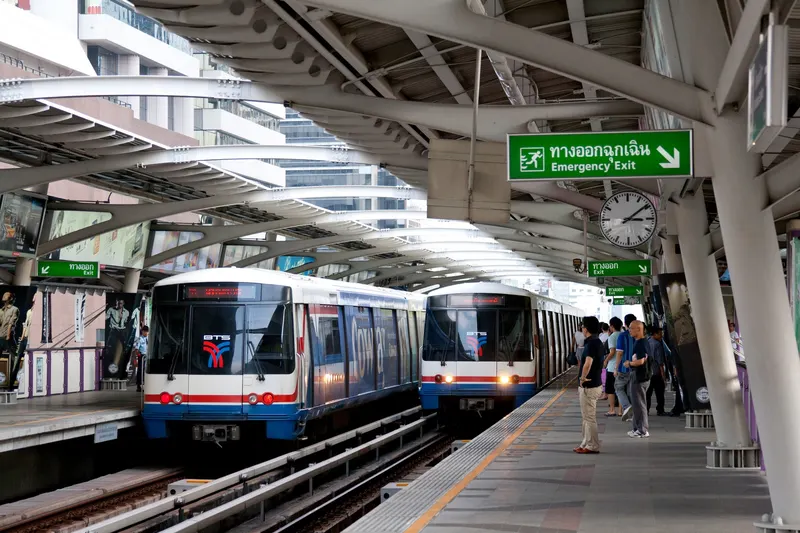
- A1–A4 buses: the budget choice, connecting to the BTS at Mo Chit and Victory Monument.
- SRT Red Line via the free airport shuttle: a calm, traffic-proof rail route.
- Official metered taxi: meter plus the airport surcharge and any tolls.
- Grab / ride-hailing: a fixed fare and a designated pickup point.

How to choose: a quick decision rule
Work through three questions in order. First, where are you staying? If your hotel is a short walk from a station on the relevant rail line, rail is usually the best blend of speed, price and predictability. Second, how much luggage and how many people? Heavy bags, small children or a group tip the balance toward a taxi, a Grab or a private transfer. Third, what time is it? At the morning and evening rush, and during rainy-season downpours, rail beats the road by a wide margin even if a taxi looks tempting.
If you are still unsure, default to rail when you can and a fixed-fare app when you cannot. Both remove the two things that go wrong most on arrival — overpaying and sitting in gridlock. Sort out a little cash and mobile data before you leave the terminal so you can book that first ride or buy a rail ticket without friction, and save your hotel's name in Thai script to show a driver.
- Hotel near the line + traveling light: take the train.
- Heavy bags, kids or a late landing: taxi, Grab or a private transfer.
- Rush hour or heavy rain: choose rail over the road every time.
- Sort cash, data and your hotel's Thai-script address before leaving the terminal.

Frequently asked questions
What is the cheapest way from Suvarnabhumi to central Bangkok? The Airport Rail Link is the cheapest reliable option when your hotel is near the line; from there you connect to the BTS or MRT. We keep the exact fare in the facts card because prices change.
Is Grab or a taxi better from the airport? A metered taxi is usually a little cheaper, while Grab removes the language barrier and shows a fixed fare upfront, which many travelers prefer late at night or with children. Either beats following a tout inside the terminal.
How do I get from Don Mueang to the city without a train at the airport? Take the A1–A4 bus to the BTS at Mo Chit, ride the SRT Red Line via the free shuttle, or use a taxi or Grab. At rush hour the bus-to-BTS combination can be the fastest door to door.
How long does the transfer take? It varies enormously with traffic. Rail times are predictable; road times can double or worse in the 7–9am and 4–8pm peaks, which is why rail is the safer bet when you have a schedule to keep.
Sources
- Suvarnabhumi transport guide (official) ↗
Official Airport Rail Link, taxi-rank and terminal transport info for BKK.
- Don Mueang Airport (official) ↗
Official A1–A4 bus, shuttle and taxi information for DMK.
- State Railway of Thailand ↗
Operator of the Airport Rail Link and SRT Red Line commuter rail.