- Time needed
- Sold all day at markets
- Best time
- Hot season (roughly March–May
- Getting there
- Markets
- Price
- A cheap street-stall plate
What you are actually eating
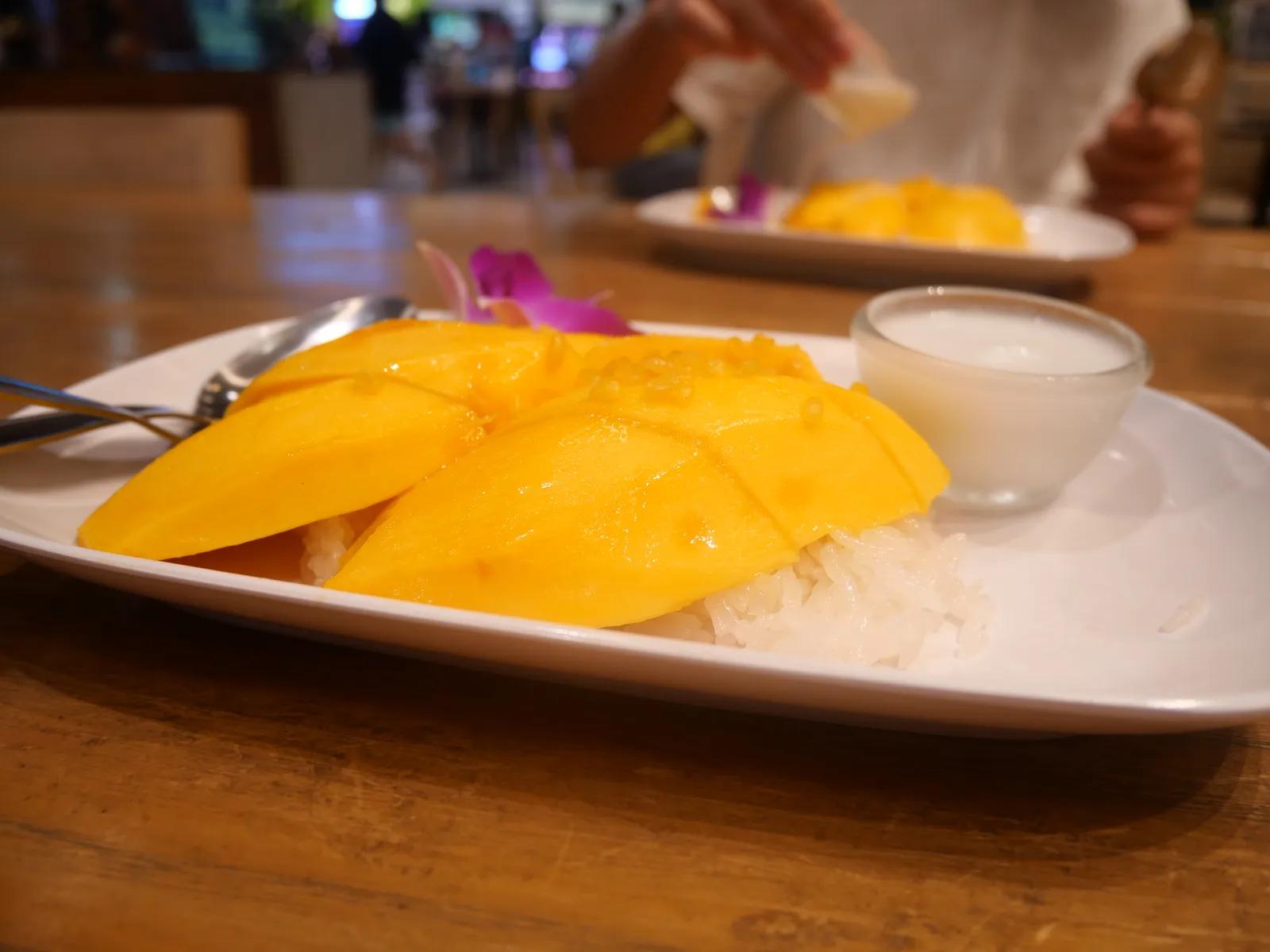
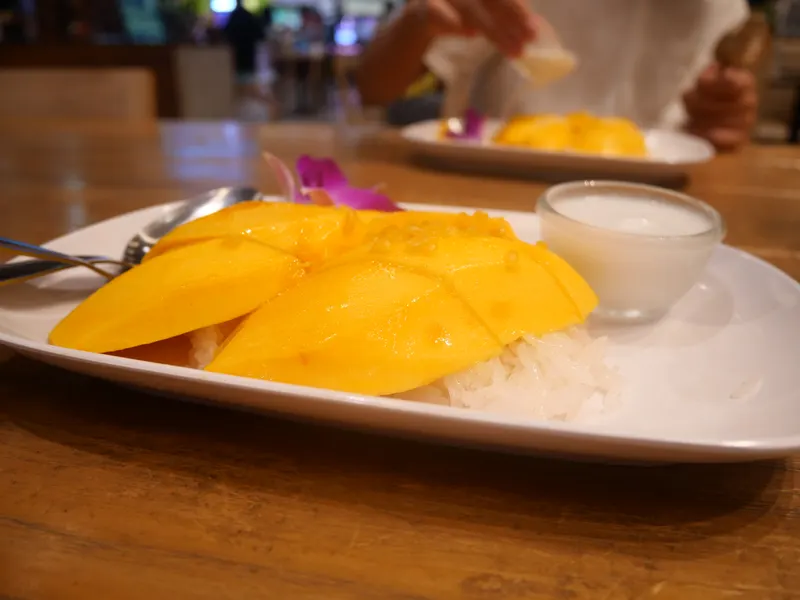
Khao niao mamuang is deceptively simple: glutinous (sticky) rice steamed until tender, then folded while warm with a coconut-milk sauce sweetened with sugar and balanced by a pinch of salt. The rice rests so it drinks up the cream, then it is plated beside slices of ripe mango and finished with a drizzle of saltier coconut topping and a scatter of toasted split mung beans for crunch.
The dish lives or dies on three things in balance. The rice should hold its shape, not turn to mush; the coconut sauce should be rich but carry a clear salty edge so it is never cloying; and the mango must be perfectly ripe, fragrant and not stringy. Get all three right and it is sublime — which is exactly why the best stalls have lines and the convenience-store versions disappoint.
The classic mango is nam dok mai, golden and almost custardy when ripe; some vendors also use the smaller, more aromatic ok rong. Either way you want fruit that gives slightly to a gentle press and smells sweet through the skin. That fragrance is the single best test of a good plate.
- Rice: glutinous, steamed, folded with coconut cream while warm.
- Sauce: coconut milk, sugar and salt — rich but with a clear salty edge.
- Topping: a saltier coconut drizzle plus crisp split mung beans for crunch.
- Mango: nam dok mai (golden, custardy) or fragrant ok rong — ripe and perfumed.

Where to get mango sticky rice
A starting shortlist of standout, currently-operating spots, by area. Hours and menus change and the best places fill up, so check the latest and book ahead where it matters — we don't quote prices.
- 01
Kor Panich (K. Panich)
฿฿฿Phra Nakhon · Thanon Tanao, near the Grand Palace / Old City
The most storied mango sticky rice in Bangkok, in business since the 1930s from a secret family recipe. Renowned for its rich sweet sticky rice, with coconut sourced from Chumphon and rice from Chiang Rai. The only mango sticky rice listed by the MICHELIN Guide Bangkok.
- 02
Mae Varee
฿฿฿Thonglor · BTS Thong Lo (corner of Sukhumvit Soi 55)
A convenient and famous stop right by Thong Lo BTS, prized for exceptionally ripe mangoes (a choice of nam dok mai or ok rong) and fresh coconut milk prepared daily. Sold in two sizes and open long hours.
- 03
Khao Niao Mamuang Chok Chai 4 (Chok Chai 4)
฿฿฿Lat Phrao · Chok Chai 4 area
Known for colourful, multi-hued sticky rice tinted naturally with butterfly pea flower (blue) and pandan (green), served with sweet mango. A long-running neighbourhood favourite.
- 04
Cho Sornkaew
฿฿฿Bangkok · neighbourhood mango sticky rice shop
A neighbourhood institution of more than 30 years, known for sticky rice flavoured with natural ingredients like strawberry, blueberry and orange alongside the classic mango pairing.
- 05
Yod Thong
฿฿฿Bangkok · long-running mango sticky rice stall
A veteran mango sticky rice maker with over four decades in the trade, widely cited among the city's best for consistently good fruit and sticky rice.
- 06
Je Meaw (Mango Sticky Rice, Sukhumvit Soi 38)
฿฿฿Phra Khanong / Thonglor · BTS Thong Lo (Sukhumvit Soi 38)
A street vendor down Sukhumvit Soi 38, a short walk from Thong Lo BTS, known for generous portions of mango sticky rice at very approachable prices.
When mango is at its sweetest
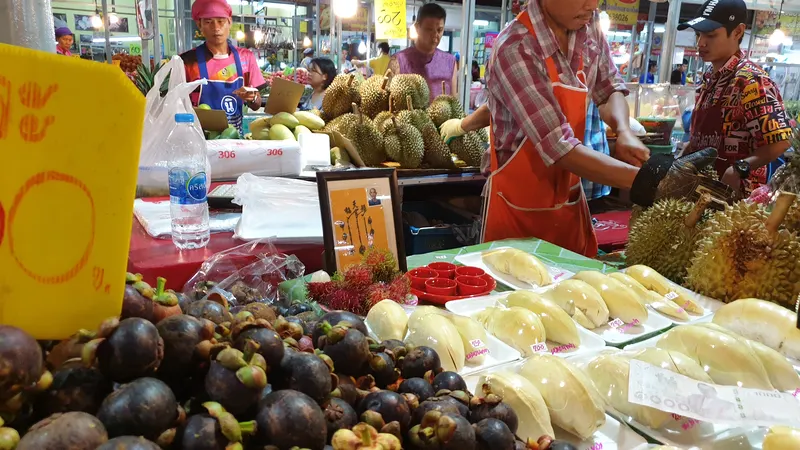
You can find mango sticky rice year-round in Bangkok, but at heart it is a hot-season treat. From roughly March through May, Thai mango trees fruit heavily, the nam dok mai turns gorgeously sweet, and a plate that costs more in the off-season eases in price as fruit floods the markets. This is the window when the dessert is at the version Thais get nostalgic about.
In the rainy and cool seasons later in the year, vendors lean more on cold-storage or firmer fruit, which can be less perfumed. The dish is still good and still everywhere, but if the perfect plate is the goal, time it for the hot months when carts pile high with golden mangoes. The exact peak shifts a little year to year with the weather, so treat the window as a guide rather than a fixed date.
A practical note that catches many visitors out: mango sticky rice is best fresh and at room temperature. The coconut sauce stiffens and the rice hardens when chilled, so do not buy a box and stash it in the hotel fridge overnight expecting it to survive — it will not be the same dessert in the morning.
- Peak season is the hot months, roughly March through May — sweetest fruit, easier prices.
- Off-season plates use firmer cold-storage fruit — still good, just less perfumed.
- The exact peak shifts year to year — treat the window as a guide.
- Eat it fresh at room temperature; never chill it overnight.



Where to find the good stuff
The famous benchmark is a long-running fruit shop near the Thong Lo BTS station that has sold mango sticky rice for decades. It is pricier than the street average and often comes as a neat boxed set with the mango and rice packed separately, which makes it both a popular gift and a reliable splurge. Go early in the day during mango season, because the best fruit sells out.
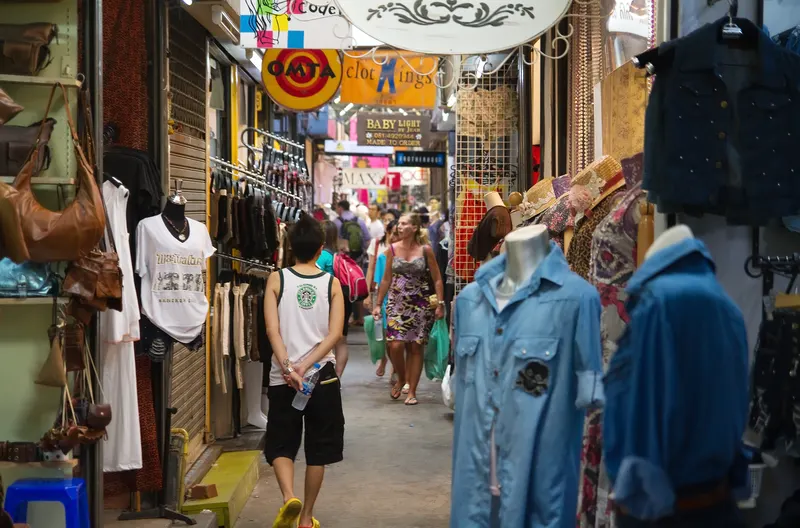
You do not need the famous name to eat brilliantly, though. Wet markets and street corners across the city have vendors who make excellent plates for a fraction of the price, often offering both plain white rice and butterfly-pea blue under the same coconut sauce. Or Tor Kor market near Chatuchak is a dependable one-roof option for high-quality fruit and dessert stalls together.
On the Thonburi side of the river and in the older lanes of the historic district, smaller stalls do quietly superb plates with hand-pressed coconut cream. The rule is the same as for all Bangkok street food: wherever you see a steaming basket of sticky rice, a pile of ripe mango and a steady stream of locals, you are in good hands.
- Famous Thong Lo fruit shop: the pricier benchmark and a popular boxed gift.
- Or Tor Kor market near Chatuchak: premium fruit and dessert stalls under one roof.
- Neighborhood wet markets: cheaper plates, often with butterfly-pea blue rice too.
- Thonburi and old-town lanes: small stalls with hand-pressed coconut cream.
How to order, eat and take it away
At a stall, just point and say khao niao mamuang. A standard plate gives you a mound of rice and half a sliced mango; if you want rice only — good for sharing, or to take away — ask for it without mango. Many vendors will pack a takeaway box with the salty coconut topping in a small separate bag, so the rice does not go soggy before you eat it.
Eat it with a spoon, scooping a little rice with each slice of mango so you get the sweet-salty-creamy contrast in a single bite. Pour the salty coconut topping over rather than stirring it in, and do not skip the split mung beans — that crunch is part of the dish at the better stalls. One plate is filling and easily shares between two people who have already had a savory meal.
Because it is so portable, mango sticky rice slots into almost any day: buy a box from a market vendor in the morning, carry it to a riverside bench or a shaded park, and share it fresh with the topping poured over. It is cheap, unhurried and quietly one of the loveliest small rituals the city offers — just eat it the same day.
- Say khao niao mamuang; ask for rice only if you want to share or take away.
- Pour the salty coconut topping over — do not stir it in — and keep the mung beans.
- One plate shares easily between two after a savory meal.
- Takeaway is easy, but eat it the same day, ideally within a couple of hours.