- Time needed
- A very long day from Bangkok (roughly 3 hours each wa…
- Best time
- Cool season (roughly Nov–Feb) for clear pools and com…
- Price
- Foreigner park entry roughly 300 THB adult / 150 THB…
- Best for
- Swimmers
What Erawan Falls actually is
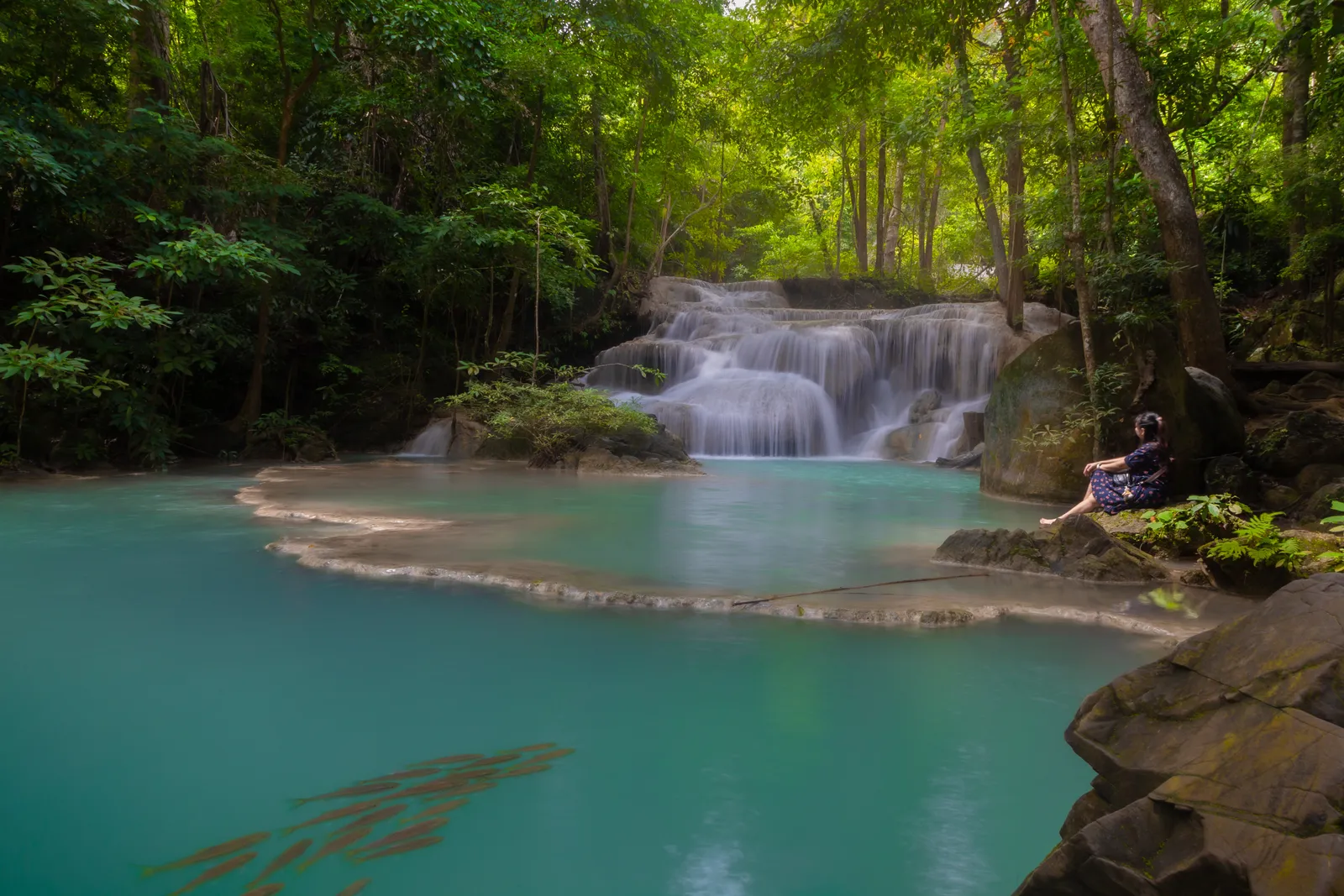
Erawan Falls is the headline natural sight west of Bangkok: a seven-level waterfall stepping down a limestone hillside inside Erawan National Park, in Kanchanaburi province near the Myanmar border. Mineral-rich water gives the pools their famous milky turquoise color, and at several tiers you can wade in and swim beneath the cascades, with small fish darting around your ankles. The name comes from the topmost tier, said to resemble Erawan, the three-headed elephant of Hindu and Thai myth.
It is genuinely one of the prettiest places in central Thailand, and unlike the temples and markets that dominate most Bangkok day trips, the draw here is nature and a swim rather than history or shopping. The catch is distance. Erawan sits well beyond Kanchanaburi town, which is already a long haul from the capital, so the falls demand more planning and more road time than almost any other destination on the day-trips menu.
If your trip is short and you want temples, ruins or markets, the closer options are an easier sell. But if you specifically want to swim in jungle pools, Erawan is the reason to point west — and it pairs naturally with the sobering River Kwai history that makes Kanchanaburi worth a night.
- Seven tiers of turquoise pools climbing a forested limestone slope.
- Most of the lower levels are swimmable; the top tier is the postcard one.
- It is about nature and swimming, not culture — a different day to Ayutthaya.
- Inside a national park, so a gate fee and park rules apply.
Watch out
Buy your park ticket only at the official National Park gate; ignore touts and unofficial 'guides' on the approach road, and never feed or chase the fish in the pools
Book ahead
Book a private car or tour ahead in peak season; you carry your park ticket back up, so keep it
Day trip or overnight? Be honest about the distance
This is the decision that makes or breaks the trip. Kanchanaburi town is roughly 130 km and two and a half to three hours west of central Bangkok by road, and the national park sits a further hour or so beyond the town. Add the climb up and down the tiers, a swim, lunch, and the return, and a same-day round trip from Bangkok becomes a very long day spent mostly in a vehicle for a few hours at the falls.
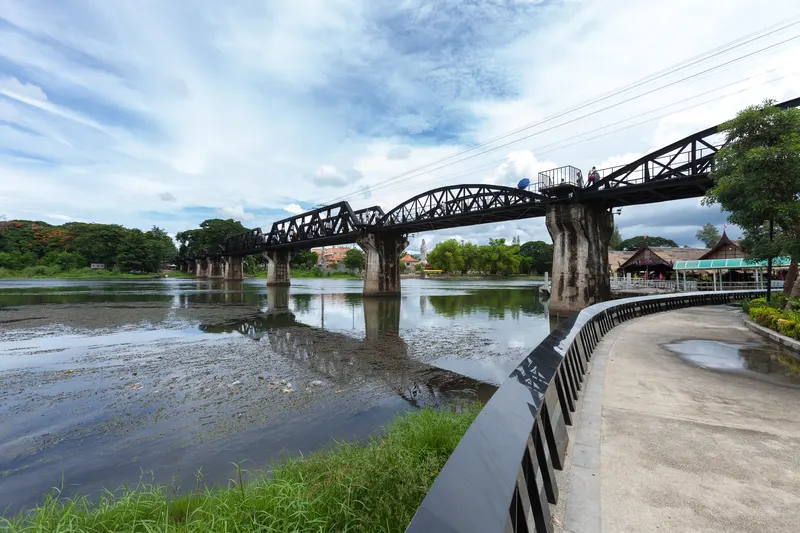
Our honest recommendation is to treat Erawan as an overnight rather than a sprint. Stay one night in or near Kanchanaburi, do the River Kwai bridge, the Thailand–Burma Railway Centre and the war cemetery in the afternoon, then drive out to the park first thing the next morning when the pools are quiet, the light is soft and the heat has not yet built. That sequence turns a stressful dash into one of the loveliest two days you can have near the capital.
If you only have a single day and you still want to go, do it on a guided tour or with a private driver so you are not navigating, and accept that you will reach the falls mid-morning when day-trippers and the heat both arrive. A self-driven day is possible but means six hours at the wheel bracketing your swim — fine for confident drivers, exhausting for most.
- Day trip: only realistic with a private driver or tour; expect a long, road-heavy day.
- Overnight: the recommended way — River Kwai history one day, falls at dawn the next.
- Reaching the falls early beats both the crowds and the worst heat on the climb.
- Don't try to stack Erawan, the bridge and Hellfire Pass into one same-day return.
Getting there from Bangkok
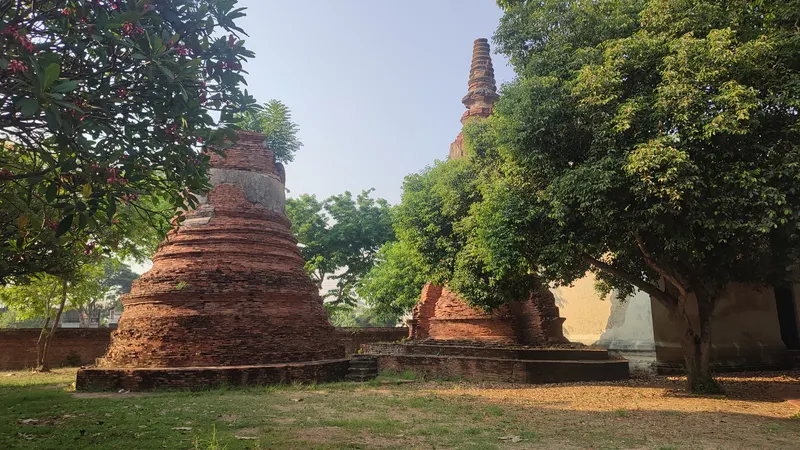
There is no direct train or public bus from Bangkok to the falls themselves, so your route is always in two legs: Bangkok to Kanchanaburi town, then Kanchanaburi to the park. For the first leg, frequent minivans and big air-conditioned buses leave Bangkok's Southern Bus Terminal (Sai Tai Mai, on the Thonburi side of the river) and take roughly two and a half to three hours. There is also a slow, atmospheric State Railway train from Thonburi station, but it is too long to combine comfortably with the falls in one day.
From Kanchanaburi town, a local public bus or songthaew runs out to the Erawan National Park gate, taking around an hour and a half — cheap but slow and infrequent, so check the last return before you head into the park. Many travelers skip that uncertainty by hiring a private car and driver for the day, which handles both legs, waits at the gate and lets you leave on your own schedule.
The simplest option for a one-day visit is a guided tour out of Bangkok, which bundles the long transfers, the park entry logistics and usually a River Kwai stop. Whichever route you take, leave central Bangkok early; a late start eats the whole day, and you will be racing Bangkok's evening traffic on the way back.
- Leg one: minivan or bus from Sai Tai Mai (Southern Bus Terminal) to Kanchanaburi, ~2.5–3 hrs.
- Leg two: local bus or songthaew from Kanchanaburi to the park gate, ~1.5 hrs, infrequent.
- Private car and driver: most flexible — covers both legs and waits while you swim.
- Guided Bangkok tour: easiest single-day option, usually with a River Kwai stop included.
- Self-drive: about 3 hrs to town via Highway 4 and Route 323, then on to the park.
The seven tiers, swimming and the climb
From the park entrance a well-marked trail follows the stream uphill, linking the seven tiers over roughly two kilometers. The lower levels are easy, mostly flat boardwalk-and-path walking, and most people can reach the third or fourth tier with little effort — these are also the most popular pools for a swim, with shallow turquoise water and small fish that nibble at your feet. The higher you climb, the wilder it gets: the path turns to roots, rock steps and short scrambles, and the crowds thin out.
The top two tiers reward the effort with the most dramatic, postcard-perfect cascades, but they are a genuine workout in the heat and humidity, so pace yourself, carry water, and wear shoes with grip rather than flip-flops. The park enforces a cut-off time after which you are not allowed to start up to the highest levels, so the top tiers are a strong reason to arrive early rather than mid-afternoon.
Swimming is the whole point, but do it respectfully: leave food and plastic outside the upper tiers (there are restrictions to protect the pools), do not feed or grab the fish, and watch your footing on the slick limestone, which is especially treacherous after rain. A change of clothes, a quick-dry towel and waterproof footwear make the day far more comfortable.
- Tiers 1–4: easy walking and the most popular swimming pools.
- Tiers 5–7: steeper, rootier climbing with the most spectacular falls and fewest people.
- There is an enforced cut-off time for starting up to the top tiers — go early.
- Bring grippy shoes, water, a quick-dry towel and a dry bag; rocks are slippery when wet.
- Protect the pools: no littering above the lower tiers, and never feed the fish.
Season, safety and a smart plan
Season changes the falls completely. The cool, dry months (roughly November to February) are the sweet spot: the pools run clear and that famous milky turquoise, the trails are firm underfoot, and the heat on the climb is bearable. The hot season (roughly March to May) still works for the lower swimming tiers but the upper climb is brutal at midday, so go at opening. The green/rainy season (roughly June to October) swells the cascades to their most powerful and the forest to its lushest, but the limestone turns dangerously slick, the water can run cloudy, and the higher tiers are sometimes closed after heavy rain.
Whatever the season, a few habits keep the day safe and pleasant. Start as early as the park allows, carry more water than you think you need, and do not push past the official cut-off for the top tiers. Watch children closely around the pools and on the wet rock, and keep an eye on the sky in the wet months, when flash storms arrive fast. Cash is useful for the gate and local transport, and you should keep your park ticket on you throughout.
Build the rest of the trip around the falls being a morning event. Reach the park early, swim and climb through the cooler hours, then return to Kanchanaburi for a riverside lunch and the bridge and museum in the afternoon — or, if you are doing the long single day from Bangkok, leave the park by early afternoon to beat the capital's evening traffic on the way home.
- Cool season: clearest pools, firmest trails, easiest climb — the best window.
- Rainy season: most powerful falls but slippery rock and possible upper-tier closures.
- Go at opening, respect the cut-off time, and watch kids on the wet limestone.
- Carry cash for the gate and transport, and keep your park ticket the whole visit.
Sources
- Thailand Department of National Parks (DNP) ↗
Official source for Erawan National Park entry fees, opening hours and seasonal tier closures.
- Erawan National Park visitor guide ↗
Current fees (foreigner ~300 THB adult / 150 THB child), 08:00–16:30 hours and the ~15:00 top-tier cut-off (2026).